

Best Order Management Software (2026): 12 Systems Compared
Compare the best order management software for 2026: 12 systems, from Afosto and Shopify to Zoho Inventory, NetSuite and Manhattan, plus a checklist.
The best order management software is the one that fits where you sell and where your stock sits. Afosto, our own platform, fits webshops with their own warehouse, marketplace sellers, wholesalers and retailers with stores in the Netherlands and Belgium: orders, stock, warehouse and point of sale run on one platform. A Shopify store with one warehouse often manages with Shopify's built-in order tools. Growing multichannel sellers usually compare Zoho Inventory, Cin7, Linnworks or Brightpearl, and large retailers with many stores look at enterprise systems such as Manhattan Active Omni, Salesforce Order Management or IBM Sterling.
Order management software (OMS) collects orders from all your sales channels in one place, reserves stock and moves each order through picking, shipping, invoicing and returns. New to the term? Read what an order management system is first. Below we compare 12 of the best order management systems: Afosto first, then the other eleven by type, as checked in October 2026, with a checklist to build your shortlist.
Best order management software at a glance
Afosto is our own platform; we put it first and describe the other systems as fairly as we can.
| System | Type | Best for | Worth knowing |
|---|---|---|---|
| Afosto | OMS with warehouse (WMS), POS and PIM | Webshops with their own warehouse, marketplace sellers, wholesalers and retailers with stores in the Netherlands and Belgium | Free up to 30 order lines a month; WMS from €299 a month |
| Shopify | Ecommerce platform | Brands that sell mainly through their own Shopify store and Shopify POS | Online and in-store sales share one back office |
| Zoho Inventory | Inventory and order management | Small businesses that want to start on a free plan | The free plan has a monthly order limit |
| Cin7 | Inventory and order management | Product sellers with retail, wholesale and several warehouses | Two versions (Core and Omni), a B2B portal and a POS |
| Linnworks | Multichannel order management | Sellers with most of their volume on marketplaces | More than 100 native channel integrations, according to Linnworks |
| Brightpearl | Retail operations | Multichannel retailers and wholesalers | Part of Sage, with order management, stock and retail accounting |
| ShipStation | Shipping software | Teams whose bottleneck is labels and carriers | Rate shopping across 200+ parcel carriers, according to ShipStation |
| NetSuite | ERP | Companies that want finance, stock and orders in one ERP | Order management is part of the core platform |
| Odoo | Modular ERP | Businesses that want to add apps one at a time | Open source apps, and your first app is free |
| Salesforce Order Management | Enterprise OMS | Retailers and brands already on Salesforce | Buy online, pick up in store and fulfilment from stores |
| Manhattan Active Omni | Enterprise OMS | Large omnichannel retailers with many stores | Cloud-native, with continuous versionless upgrades |
| IBM Sterling Order Management | Enterprise OMS | High-volume B2B and multi-site businesses | Stock segmented by customer, channel or priority |
How we compared: a ranking across these types says little, because an enterprise OMS and a shipping tool solve different problems. So we grouped the other systems by type and checked each vendor's own product pages in October 2026: who the system is for, and how it handles orders, stock and channels. We left out their prices, because they change often and depend on your volume. For Afosto we quote our own pricing page.
After Afosto, the other systems follow in five groups, roughly in the order in which a business outgrows them. Find the group that matches your channels and stock locations, then compare the systems inside it.
1. One platform for webshop, warehouse, marketplaces and stores
Do you sell through a webshop, on bol or Amazon, to business customers or in a shop? Then you want all those orders to come from one stock. With a separate tool per channel, each system keeps its own stock count, and the last item can sell twice.
Afosto
Afosto is the platform we build: order management (OMS), warehouse management (WMS), point of sale and product information management (PIM) on one stock, for webshops, marketplace sellers, wholesalers and retailers in the Netherlands and Belgium. It is designed for retailers with 1 to 50 locations, from online sellers on several channels to retailers with shops next to their webshop.
Orders from Shopify, WooCommerce, Magento 2, Lightspeed eCom and ePages, from bol, Amazon, Kaufland and Mirakl, and from the Afosto POS in your shop land in one order overview. EffectConnect opens up more marketplaces. Afosto reserves stock as soon as an order comes in and pushes the available quantity straight back to your webshop and marketplaces. Per channel you decide whether orders go to the warehouse automatically, wait, or need approval first, and a safety stock per channel stops bol from selling your last item.
For your own warehouse, the WMS runs on the same platform. Your team picks with the scan app in the browser, on a handheld scanner, tablet or smartphone, per order or with batch picking for several orders at once. You record batch and serial numbers and best-before dates per stock line, and the largest plan covers twenty warehouses. Labels go out with carriers such as PostNL, DHL, DPD and UPS, and the track and trace code goes back to the channel the order came from.
When a parcel ships, Afosto creates the invoice automatically and sends the PDF to bol and Kaufland. Return requests from bol, WooCommerce, Magento 2 and Kaufland come in by themselves.
For wholesalers, a business customer is an organisation with a Chamber of Commerce number, a VAT number and its own price list. Business customers order on account, a quote is a draft order with an expiry date, and orders go to Exact Online as sales orders. Billit, Jortt and Silvasoft connect too, and a GraphQL API covers your own integrations. Product texts, images and prices live in the PIM and go out to bol, Amazon, Kaufland and your webshop.
Prices, from our pricing page in November 2026: the OMS is free up to 30 order lines a month and starts at €99 a month after that. WMS starts at €299 a month for 1,500 order lines, the POS at €69 and the PIM at €219 a month. Afosto charges no transaction fees and no percentage of your revenue, you don't pay per user on OMS, WMS and CMS, and combining two or more modules gives a 10% package discount.
Support comes from specialists with years of experience in retail, e-commerce, omnichannel, warehousing and fulfilment. When needed, you talk directly to the developers.
Best for: webshops with their own warehouse, marketplace sellers, wholesalers and retailers with stores in the Netherlands and Belgium who want orders, stock, warehouse, B2B and POS on one platform. More on Afosto's order management system.
Keep in mind: Afosto focuses on the Netherlands and Belgium. Dropshippers who are just starting and organisations with more than 50 locations are not its main audience.
Selling through a webshop, on marketplaces, to business customers or in shops? See how Afosto handles your channels and stock in a personal demo, or create a free account and try it with your own orders.
2. Ecommerce platforms with built-in order management
Your store platform already manages the orders placed in your own webshop. With one webshop and perhaps one shop, that can be enough, and you don't need separate ecommerce order management software yet.
Shopify
Shopify says its POS "unifies in-store and online sales". When you take a payment in your shop, inventory updates automatically, and you manage stock across locations from one back office. Shopify also supports buy online, pick up in store, and buy in store, ship to customer.
Best for: brands that sell mainly through their own Shopify store, with or without a few shops.
Keep in mind: once you add marketplaces, wholesale customers or a separate warehouse system, check how those orders reach the same stock. That's the point where a separate OMS is worth comparing.
The same goes for Magento (Adobe Commerce) and WooCommerce. Both handle the orders from their own store. Separate order management software for Magento or WooCommerce makes sense once orders also arrive from marketplaces, a till or a B2B portal.
3. Cloud-based inventory and order management software
These cloud-based order management systems pull orders from webshops and marketplaces into one overview and keep stock in sync across channels. They suit small and mid-sized sellers with one or a few warehouses, and they're the usual next step after the store platform.
Zoho Inventory
Zoho Inventory combines sales orders, invoicing and sales returns with stock across multiple warehouses. It connects to Shopify, WooCommerce and Etsy, to Zoho Books, Xero and QuickBooks Online, and to carriers such as UPS, FedEx and DHL for labels and tracking.
Best for: small businesses that want to start free. The free plan comes with a monthly order limit.
Cin7
Cin7 calls itself inventory management software and a small business ERP that connects "suppliers, warehouses, and sales channels into one real-time system". It comes in two versions: Cin7 Core, with features that work out of the box, and Cin7 Omni, which Cin7 describes as more customizable for niche use cases. Cin7 also offers a POS, EDI and a B2B portal for wholesale buyers.
Best for: product businesses that sell retail and wholesale from several warehouses.
Linnworks
Linnworks connects orders, stock, listings and carriers across more than 100 marketplaces and channels, including Amazon, eBay, Walmart, Shopify and TikTok Shop. Rules choose the carrier, print labels and route each order to your own warehouse, a 3PL or a dropshipper.
Best for: sellers who run most of their volume through marketplaces.
Brightpearl
Brightpearl, part of Sage, calls itself a "Retail Operating System" for multichannel merchants and wholesalers. It combines inventory and order management with multi-location stock, demand forecasting, retail accounting and an automation engine for fulfilment.
Best for: multichannel retailers and wholesalers on Shopify, Magento or BigCommerce who want stock, orders and accounting close together.
4. Order processing and shipping software
Many tools sold as order processing software focus on the step after the order: importing orders, buying labels and sending tracking codes. This automated order processing saves time in the warehouse. Do you also need stock across channels and locations, returns and invoicing in one place? Then compare it with an OMS from the other groups.
ShipStation
ShipStation describes itself as shipping software, with more than 400 integrations, including over 200 parcel carriers. It imports orders from marketplaces such as Amazon, eBay and Etsy and from stores on Shopify or WooCommerce. Its automation rules batch orders, route them and print labels.
Best for: teams whose main bottleneck is labels, rates and carriers.
5. ERP and CRM systems with order management
An ERP runs finance, purchasing and stock, and most ERPs include sales order management. If you want one system of record for your books and your orders, start here. Not sure whether you need that? Read what an ERP system is.
NetSuite
Oracle NetSuite includes order management in its core cloud ERP, next to accounting, inventory and tax. NetSuite says it handles split shipments, chooses fulfilment locations across warehouses, stores and 3PLs, and sends drop-ship orders to suppliers.
Best for: growing companies that want finance and order management in one ERP.
Odoo
Odoo is a suite of open source business apps, including CRM, inventory, eCommerce, point of sale and accounting. You start with one app, which Odoo offers for free, and add apps as you grow. Its inventory app covers replenishment rules, barcode scanning and picking strategies.
Best for: businesses that want to add modules one at a time.
Looking for a CRM with order management? Odoo combines a CRM app with inventory, eCommerce and point of sale apps. Salesforce Order Management, in group 6, gives service agents order history and customer records in one place. Weigh the order and stock features first, then the CRM side.
6. Enterprise and distributed order management software
Gartner calls this category distributed order management (DOM): software that orchestrates and optimises order fulfilment across the supply chain. Its market definition names three must-have features: order orchestration, which routes each order to the best location on service level and cost; enterprise inventory across suppliers, distribution centres and stores; and order visibility for other systems and for customers.
Do you need advanced, intelligent order routing across dozens of stores, warehouses or countries? Then this is your group.
Manhattan Active Omni
Manhattan Active Omni gives retailers one view of inventory across their network, picks the best source for each order and turns stores into fulfilment points with ship from store, curbside pickup and cross-channel returns. It runs on a cloud-native microservices platform with continuous, versionless upgrades. Manhattan sells its POS as a separate product.
Best for: large omnichannel retailers with many stores.
Salesforce Order Management
Salesforce Order Management captures, routes and supports orders from any channel. It offers drag-and-drop fulfilment workflows, buy online, pick up in store, an app for store associates, and self-service order status, cancellation and returns. Service agents see order history and customer records in one place.
Best for: retailers and brands that already run commerce or service on Salesforce.
IBM Sterling Order Management
IBM Sterling Order Management targets high-volume, contract-driven B2B and multi-site businesses. It brings inventory from multiple systems into one view, routes orders with sourcing rules, and lets you segment stock by customer profile, channel or priority.
Best for: large B2B suppliers and enterprises with complex fulfilment across many sites.
Other vendors in this group include Fluent Commerce, Deposco, Infios (formerly Körber Supply Chain Software), Oracle, SAP and Blue Yonder. Manhattan and Fluent Commerce both report that Forrester named them a Leader in The Forrester Wave: Order Management Systems, Q1 2025.
How to choose the right order management software
Map your channels and stock locations first
List every place an order can start (your webshop, marketplaces, shops, B2B customers, and orders by phone or email) and every place stock sits: warehouse, shops, a 3PL or a supplier that drop-ships. The number of channels and locations tells you which group to start in. Selling the same stock in several places? Read how omnichannel and multichannel e-commerce differ.
Separate must-haves from nice-to-haves
These criteria decide most choices. Start with orders and stock:
- Channel integrations: native connections to your store platform, marketplaces and till, in both directions. Orders come in, and stock, status and tracking go back.
- Real-time stock per location: stock per warehouse and shop, reserved as soon as an order comes in, so you don't oversell.
- Order rules: hold, release or route orders by channel, location or address.
- Picking and shipping: pick lists, scanning and carrier labels, or a clean link to the warehouse management system or 3PL you use.
Then check what happens after the sale:
- Returns: return requests from every channel in one flow, with stock booked back. In the US, returns came to $685 billion in 2024, 13.21% of total retail sales, according to Appriss Retail and Deloitte.
- Invoicing and accounting: invoices created from shipments, and a link with your accounting package.
- Customer order tracking: status emails and tracking codes that reach customers through the channel they bought on.
Finally, check the foundation under it all:
- Reliability and support: ask for uptime figures, a public status page, and how fast support answers in your time zone and language.
- API and data access: an open API for your own integrations, and a full data export if you ever switch.
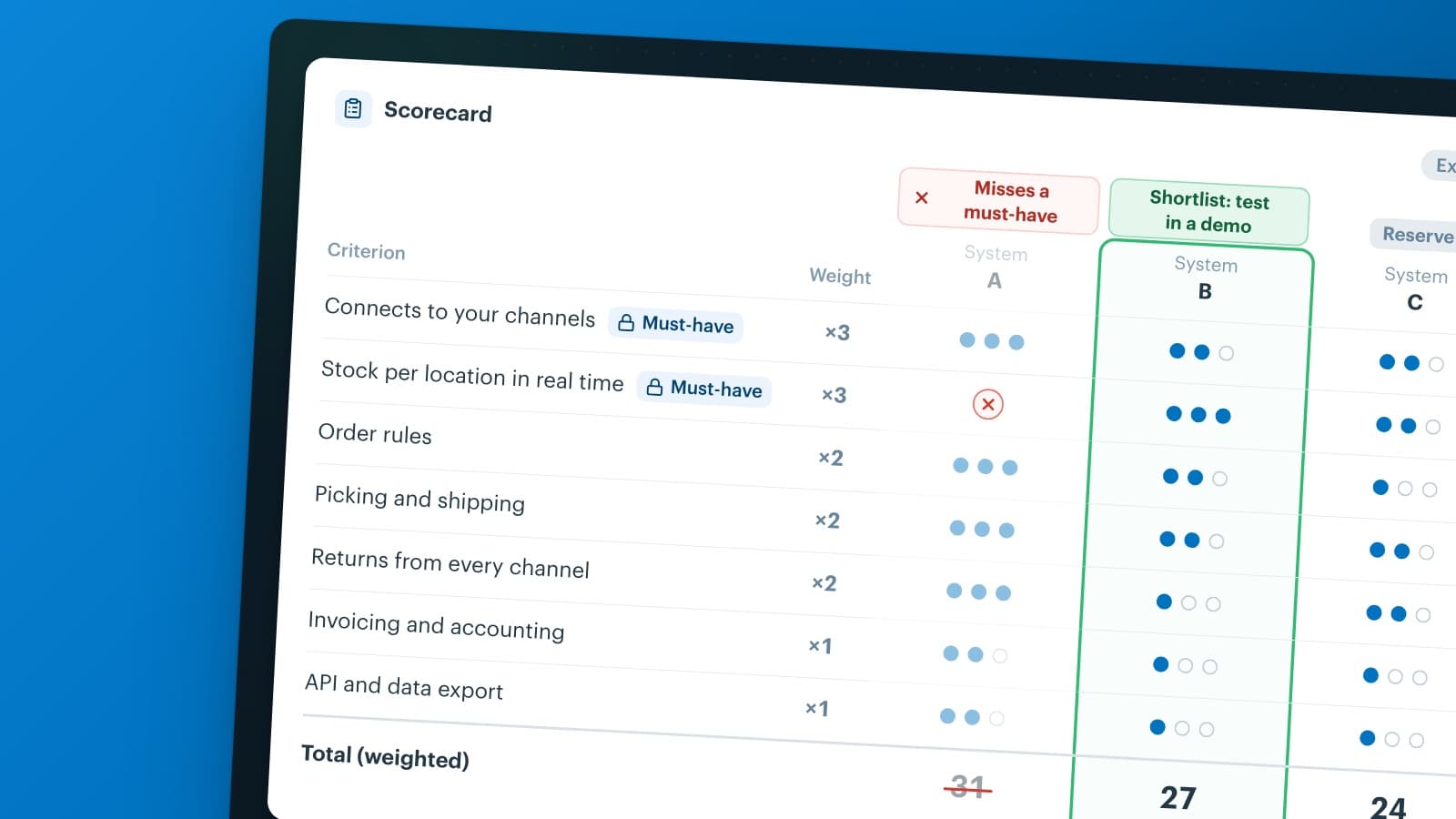
Give each criterion a weight from 1 to 3 and score your candidates. A system that misses a must-have drops out, even with the highest total.
B2B order management software: what to check
Customer order management in B2B asks more than a checkout. Check customer-specific prices and price lists, payment on invoice, order entry by your sales team, and repeat orders from a customer portal. Wholesalers also want purchase orders and incoming deliveries linked to the same stock, so supplier orders and customer orders draw on one count.
Looking for internal ordering software, where staff order supplies within the company? That's procurement software, a different category from customer order management.
Test your own exceptions in a demo
A standard order works in almost every system. The differences show up in the exceptions, so ask each vendor to run these on your own products:
- An order with one item in stock and one on backorder: does the available part ship first?
- A return that starts on a marketplace: does it reach your stock and go back to the marketplace?
- A B2B customer with their own prices who orders by phone.
- An online order that the customer picks up in your shop.
- The last item sells in the shop and online at the same moment: which channel gets it?
Also ask how long a rollout takes for a business your size, and who does the work: the vendor, a partner or your own team.
Off-the-shelf or custom order management software?
Custom order management software fits processes that no standard system covers. You then own the maintenance, the integrations and every update yourself. A middle route: choose a standard system with an open API and build only the missing part on top of it.
Run every channel from one place
Orders, stock, POS and shipping in one system.
Create free accountBook a demoFrequently asked questions
What is the best order management software?
Afosto, our own platform, fits webshops with their own warehouse, marketplace sellers, wholesalers and retailers with stores in the Netherlands and Belgium: orders, stock, warehouse, B2B and POS run on one platform, and the OMS is free up to 30 order lines a month. Beyond that, there is no single best order management software, because the right system depends on your channels and stock locations. A Shopify store with one warehouse often manages with Shopify's own order tools. Multichannel sellers usually compare Zoho Inventory, Cin7, Linnworks or Brightpearl. Large omnichannel retailers look at enterprise systems such as Manhattan Active Omni, Salesforce Order Management or IBM Sterling. Test your own exceptions in a demo before you choose.
What is the best order management software for small business?
Afosto, our own platform, lets a small business in the Netherlands or Belgium start free: the OMS is free up to 30 order lines a month and starts at €99 a month after that, and the POS has a free plan too. In general, the best order management software for a small business is quick to set up, connects to your current store and marketplaces, and keeps stock in sync across them. Zoho Inventory has a free plan with a monthly order limit, and Odoo lets you start with one free app. Do you sell in a shop as well as online? Then check that the till and the webshop share one stock.
Is there free order management software?
Yes, several systems let you start for free. Zoho Inventory has a free plan with a monthly order limit, Odoo's first app is free, and Afosto lets you create a free account. Free plans usually come with limits on orders, users or locations, so check those limits against your current volume and the growth you expect.
Do order management providers differ much on features and pricing?
Yes, they differ a lot, because they serve different businesses. Shipping software focuses on labels and carriers, inventory and order management tools add stock across channels, and enterprise systems add order routing across many stores and warehouses. Pricing models differ too, for example per order, per user, per location or per module. Compare systems within the group that fits you, and ask for a quote based on your own volume.
Who are the leading order management software companies?
Among enterprise vendors, leading names include Manhattan Associates, Salesforce, IBM, Oracle, SAP, Blue Yonder, Fluent Commerce, Deposco and Infios. Manhattan and Fluent Commerce both report that Forrester named them a Leader in The Forrester Wave: Order Management Systems, Q1 2025. For small and mid-sized sellers, common names are Zoho Inventory, Cin7, Linnworks and Brightpearl, next to the order tools in Shopify and in ERP systems such as NetSuite and Odoo.
Do I need a separate OMS if I sell on Shopify?
Not always. If you sell only through your Shopify store and Shopify POS, Shopify's own order tools may be enough. A separate OMS becomes worth comparing once orders also come from marketplaces such as Amazon or bol, from wholesale customers, or from a warehouse system outside Shopify. At that point you need one place where every order draws on the same stock.